
Apparel & fashion
Garment Handling Conveyors for Apparel Distribution
Garment handling conveyors move folded, bagged and boxed apparel from the end of production through checking, sorting and packing to dispatch, keeping garments clean and orders accurate. EKA builds these lines to suit your products and floor.
- Gentle, clean handling
- Belt & roller options
- 12+ years of experience
Why Conveyors Matter in Garment Distribution
Apparel moves in high volumes and many variants: every style comes in several sizes and colours, and each retail store or online order needs its own mix. Handling all of that by hand is slow and is where most mix-ups happen.
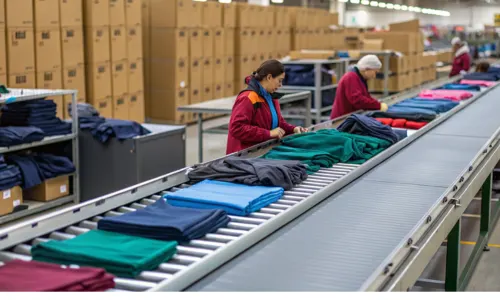
Conveyors connect the finishing area, quality checking, sorting, packing and dispatch, so garments flow steadily from one stage to the next. Staff stay at their workstations, garments are not dragged across the floor and every item passes the same scanning and checking points. That supports faster replenishment of stores and quicker turnaround of online orders.
Conveyor Types for Garment Handling
Flat-packed garments are usually handled on belts; cartons and totes on rollers.
Belt conveyors
A smooth, continuous surface for folded and polybagged garments that would snag or fall between rollers.
Roller conveyors
For cartons and totes of garments, including gravity sections at packing and loading.
Assembly line conveyors
Workstation conveyors for finishing, folding, tagging and packing operations.
How it works
Garment Handling Applications
Where conveyors fit from production to dispatch.
Production line transport
Finished garments travel from stitching and finishing to checking, removing bundles carried by hand and reducing bottlenecks.
Quality check and tagging
A belt line with workstations alongside lets staff inspect, tag and label garments at a steady pace.
Folding and bagging
Garments move on to folding and polybagging stations and then to sorting.
Sorting by store or order
Garments or cartons are routed to lanes for each store, online order batch or carrier.
Packing and shipping
Packed cartons go by roller conveyor to sealing, labelling and the loading dock.
Benefits for Apparel Businesses
- Faster throughput: garments move continuously between stages, shortening lead times in peak season.
- Fewer order errors: fixed scanning and sorting points reduce wrong sizes and colours going to stores or customers.
- Cleaner, gentler handling: garments stay off the floor and are not crushed in overfilled trolleys.
- Better use of space: conveyors replace trolley parking and can use height in multi-level buildings.
- Less staff fatigue: fewer lifts and less walking with bundles and cartons.
For garment lines we normally recommend a smooth-top PVC conveyor belt or a PU conveyor belt with clean edges, so fabric does not snag.
Choosing a Garment Conveyor
Match the conveyor to the way garments are presented.
| Garment form | Suggested conveyor | Notes |
|---|---|---|
| Loose folded garments | Belt conveyor, smooth PVC or PU belt | Side guides to keep stacks aligned |
| Polybagged garments | Belt conveyor | Bags can slip on rollers or inclines; use a belt, cleated if inclined |
| Garments in cartons or totes | Roller conveyor | Powered or gravity depending on run |
| Workstation tasks (check, tag, fold) | Assembly line belt conveyor | Bench height and station spacing set to the task |
| Moving between floors | Inclined cleated belt or spiral conveyor | Check the minimum item size for spirals |
Get an accurate quote
What to Send Us for a Quote
Give us these details and we will propose a layout.
- Garment forms handled: loose, folded, polybagged, cartons or totes
- Item and carton sizes and weights
- Pieces or cartons per hour at peak
- Process stages to connect and number of workstations
- Floor plan, including any level changes
- Number of sort destinations (stores, orders or carriers)
Talk to a conveyor specialist
Send your requirement, get a clear answer
Share a photo, sketch or a few numbers. We reply within one working day.
- Call+91 93640 87778
- WhatsAppChat with us
- Emailcontact@ekaconveyors.com
Recommended EKA Conveyors
EKA products suited to garment handling.
FAQs
Frequently Asked Questions
Quick answers about garment handling.
Will a conveyor damage delicate fabrics?
Not if it is specified correctly. A smooth-top PVC or PU belt with properly finished edges and guides avoids snagging, and keeping garments off the floor actually reduces soiling and crushing.
Should garments run on belts or rollers?
Loose and polybagged garments should run on belts, because they can catch or slip between rollers. Cartons and totes of garments run well on roller conveyors.
Can a conveyor sort garments by store or size?
Yes. With a scanner and divert points, garments or cartons can be routed to lanes by store, order, size or style. We design the conveyor layout around your sorting logic.
Can the conveyor include workstations for checking and tagging?
Yes. Assembly-line style conveyors can be built with workbenches alongside, at a height and spacing that suits each task.
Do you handle multi-storey garment units?
Yes. Inclined cleated belts or spiral conveyors can move garments and cartons between floors.
Can the line run at different speeds for different products?
Yes. A variable speed drive (VFD) can be fitted so the line speed can be matched to the product and staff pace.
Next step
Talk to Us About Your Garment Line
Tell us how your garments are presented and how many you handle per hour, and we will reply within one working day. Call or WhatsApp +91 93640 87778 or email contact@ekaconveyors.com.
Real people, real answers. We reply within one working day.